The Man Who Survived Two Atomic Bombs:
The Unbelievable Story of Tsutomu Yamaguchi
History is full of stories that seem impossible—stories that challenge what we believe a human being can endure. But among them all, one stands out as almost beyond comprehension. It’s the story of a man who survived not one, but two atomic bombings during one of the darkest chapters in human history.
His name was Tsutomu Yamaguchi.
And his life is more than just a historical footnote—it’s a powerful reminder of survival, suffering, and the responsibility of memory.
A Quiet Life in Nagasaki
Before the World Changed
Born on March 16, 1916, in Nagasaki, Japan, Tsutomu Yamaguchi was, by every measure, an ordinary man living an ordinary life. He worked as a skilled marine engineer for Mitsubishi Heavy Industries — a respected profession in a nation whose industrial ambitions were fused with military purpose. At home, he was a devoted husband and a loving father to a young son.
Like millions of Japanese civilians in the summer of 1945, Yamaguchi moved through the rhythms of daily life — work, family, meals, routine — even as the war ground relentlessly toward its conclusion. American B-29 bombers had begun firebombing Japanese cities. The country’s military position was deteriorating. Air raid drills became a fact of life.
Yet amid all of that tension, nothing — no warning, no premonition, no act of God — could have prepared him for what was about to happen. Twice.
Hiroshima, August 6, 1945
The First Flash
In early August 1945, Yamaguchi was wrapping up a three-month work assignment in Hiroshima — a city of roughly 350,000 people, a major military and industrial hub that had, so far, been spared the worst of the Allied bombing raids. On the morning of August 6th, he was making his way toward the Mitsubishi shipyard when he realized he had left behind a critical document — his personal seal, an essential stamp in Japanese professional life.
He turned back.
That split-second decision placed him on a specific street, at a specific time, in a specific location that would define the rest of his existence.
8:15 a.m. The sky split open.
The Enola Gay, a United States Army Air Forces B-29 bomber, released ‘Little Boy’ — a uranium bomb packing the explosive power of approximately 15,000 tons of TNT — over the center of Hiroshima. The bomb detonated roughly 600 meters above the ground. The fireball reached temperatures hotter than the surface of the sun.
Yamaguchi was standing approximately three kilometers from the hypocenter. At that range, the blast wave hit with the force of a freight train. The flash — brighter than anything the human eye was designed to process — temporarily blinded him. The pressure wave ruptured both of his eardrums and hurled his body through the air, slamming him into a field. His left arm and the upper half of his body were exposed to severe thermal radiation, burning his skin in ways that would mark him for life.
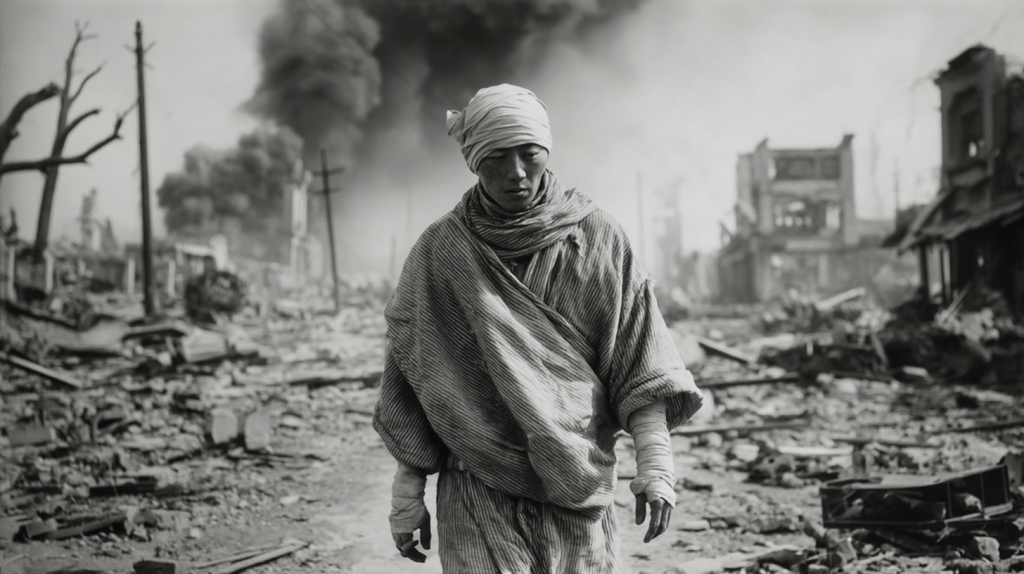
Around him, Hiroshima ceased to exist as a functioning city. Buildings were flattened. The air was thick with ash, dust, and the screams of the dying. Fires erupted across the ruins. Roughly 70,000 to 80,000 people were killed instantly; tens of thousands more would die in the days and weeks that followed from injuries and radiation sickness.
Yamaguchi dragged himself to consciousness, found shelter in an air raid bunker, and waited out the nightmarish hours as the city burned around him. He was injured, half-blind, and in agonizing pain — but alive.
Surviving Hiroshima
The Decision to Go Home
In the aftermath of the bombing, Yamaguchi did something that still feels almost incomprehensible in retrospect: he decided to go home.
Bandaged, burned, his hearing severely damaged, he navigated the rubble and chaos of what remained of Hiroshima and made his way to a train. The journey back to Nagasaki — a city of around 250,000 people nestled between the mountains of Kyushu — was harrowing. The infrastructure was strained. Fellow passengers were dazed and broken. Yet Yamaguchi pressed on, driven by the singular pull of family — his wife, Hisako, and their young son waiting for him at home.
He arrived in Nagasaki battered, irradiated, and barely functioning. By any reasonable medical standard, he should have been hospitalized, perhaps indefinitely. Instead, after two days of recovery, Yamaguchi reported back to work at the Mitsubishi facilities in Nagasaki.
He had, in the language of probability, already used up a lifetime’s worth of luck.
History had other plans.
Nagasaki, August 9, 1945
Lightning Strikes Twice
On the morning of August 9th, three days after Hiroshima, Yamaguchi sat in his supervisor’s office and attempted to describe what he had witnessed — a single bomb that had annihilated a city. His supervisor reportedly struggled to believe him. The idea that any single weapon could achieve such destruction was, at that moment in human history, almost beyond rational comprehension.
And then the room turned white.
At 11:02 a.m., the B-29 bomber Bockscar released ‘Fat Man’ — a plutonium implosion bomb — over Nagasaki. The bomb detonated approximately 500 meters above the Urakami district. The resulting explosion yielded roughly 21,000 tons of TNT equivalent, even more powerful than the Hiroshima bomb.
Yamaguchi was less than two miles from the hypocenter.
For the second time in seventy-two hours, he was engulfed in a blinding flash of nuclear light. For the second time, a shockwave tore through the air around him. For the second time, he was thrown from his feet by forces that killed tens of thousands of others.
The Nagasaki bomb killed an estimated 40,000 people instantly, with total casualties eventually reaching between 60,000 and 80,000. Yamaguchi’s bandages were blown off by the blast. His existing wounds were exposed and re-traumatized.
And yet, impossibly, Tsutomu Yamaguchi survived again.
The Price of Survival
Radiation Sickness and Lifelong Illness
Surviving two atomic blasts was extraordinary. What came next was its own prolonged ordeal.
In the weeks following the bombings, Yamaguchi’s body began to break down under the cumulative weight of radiation exposure. The symptoms of acute radiation syndrome set in with brutal consistency:
- Relentless high fever
- Complete hair loss
- Severe and continuous vomiting
- Extreme fatigue and physical weakness
- Open wounds that refused to heal normally
These were not temporary setbacks. The radiation damage was woven into the fabric of his biology. Over the years, Yamaguchi would develop partial deafness from the ruptured eardrums sustained at Hiroshima. He developed cataracts. He suffered from chronic pain related to his burn injuries. He contracted leukemia — a disease closely associated with radiation exposure — as well as other recurring illnesses over the course of his long life.
His wife, Hisako, also suffered significant radiation-related health effects, including cataracts severe enough to leave her nearly blind. Their family was irradiated from within, carrying the invisible legacy of August 1945 in their bodies for decades.
The physical cost was immense. But there was another dimension of suffering that is harder to quantify.
Decades of Silence
The Weight of Being Hibakusha
For the better part of the next sixty years, Tsutomu Yamaguchi said almost nothing publicly about what he had experienced.
This silence was not unique to him. It was the silence of an entire generation. The hibakusha — the Japanese term for atomic bomb survivors, literally ‘explosion-affected people’ — carried their trauma in near-total isolation, often surrounded by a society that did not know how to hold their experience.
The stigma was suffocating. Many hibakusha found it difficult to secure employment; employers worried, sometimes irrationally, that their radiation exposure would make them unreliable or contagious. Marriage prospects were complicated by fears — often baseless — that radiation damage could be passed to children. Some survivors found themselves objects of pity, others of quiet fear.
For many hibakusha, the deepest wound was simply not being believed — or being believed but found too painful to fully acknowledge. The scale of what they had witnessed was so enormous, so outside the realm of ordinary human experience, that communication itself seemed to fail.
Yamaguchi raised his family, continued his work, and kept the memories sealed behind a wall of private anguish. But as the years passed and the witnesses to those August mornings grew fewer in number, something shifted inside him.
Silence, he began to feel, was no longer enough. Silence was, in its own way, a betrayal of those who had not survived.
Breaking the Silence
A Voice Against Nuclear Weapons
In his later decades, Tsutomu Yamaguchi made a deliberate and courageous choice: he began to speak.
He gave interviews. He wrote about his experiences. He met with students, peace activists, and government officials — anyone who would listen — and recounted, with careful detail, what it felt like to stand inside a nuclear explosion. Not once, but twice. He participated in peace memorial events in Hiroshima and Nagasaki. He became a fixture in the international disarmament conversation.
In 2006, at the age of 90, he traveled to the United Nations in New York and addressed the body directly, calling on world leaders to commit to the elimination of nuclear weapons. The framing of his appeal was simple and devastating: he was not speaking in theory or from policy papers. He was speaking from two mornings in August 1945 that he would never stop seeing behind his eyes.
“Having experienced atomic bombings twice… it is my destiny to talk about it.”
That word — destiny — is not accidental. Yamaguchi did not experience his survival as mere fortune. He came to understand it as obligation. The universe, or history, or chance had kept him alive, and the only worthy response was to ensure that those two explosions were never forgotten, never minimized, and never repeated.
Official Recognition
Japan’s Only Certified Double Survivor
While Yamaguchi was almost certainly not the only person present in both Hiroshima and Nagasaki during the bombings — historians estimate that a few hundred people may have been in both cities — he is the only individual ever officially recognized by the Japanese government as a nijū hibakusha: a ‘double bomb-affected person.’
That recognition was granted in March 2009, when Yamaguchi was 93 years old. It came after he provided extensive documentation of his presence in both cities — eyewitness accounts, medical records, employment records, and official testimony — satisfying the government’s rigorous evidentiary standards.
The delay — more than six decades between the events and their official acknowledgment — speaks to the difficulty hibakusha faced in being seen, recorded, and formally witnessed by the institutions of the state. Many survivors who may have shared a similar double experience went unrecognized simply because they lacked documentation, did not come forward, or died before official processes could be completed.
For Yamaguchi, the recognition was validation — but more than that, it was an official anchor in the historical record. His story, certified by the government of Japan, could not be dismissed or diminished.
The Legacy of Tsutomu Yamaguchi
One Survivor, One Imperative
Tsutomu Yamaguchi died on January 4, 2010, at the age of 93. The official cause of death was stomach cancer — a disease with a well-documented association with radiation exposure. He lived for nearly 65 years after the bombs, through the reconstruction of Japan, the Cold War arms race, the rise of nuclear proliferation, and the slow, imperfect global movement toward disarmament.
He outlived most of his generation. He outlived the certainty that nuclear weapons would never be used again. And in his final years, he used every remaining breath to argue that the world could not afford to forget what he had seen.
His legacy exists on multiple levels. As an individual, he represents the extraordinary resilience of the human body and spirit — the capacity to endure the unendurable and still choose purpose over silence. As a historical witness, he is irreplaceable: one human being who experienced both nuclear detonations in warfare and lived to describe them in granular, visceral detail.
And as a symbol, Yamaguchi’s story carries a weight that statistics and policy arguments cannot replicate. He is not an abstraction. He is not a casualty figure or a diplomatic footnote. He is a man who stood inside two nuclear explosions and decided that survival came with a responsibility.
Why This Story Still Matters
The Threat That Never Went Away
It would be comfortable — and deeply wrong — to read Yamaguchi’s story as a relic of a finished chapter. The atomic bombings of Hiroshima and Nagasaki ended World War II, but they did not end the nuclear age. Today, nine countries are estimated to possess nuclear weapons. The global stockpile, while reduced from Cold War peaks, still numbers in the thousands of warheads. Geopolitical tensions involving nuclear-armed states remain a defining feature of international relations.
The Treaty on the Prohibition of Nuclear Weapons, which opened for signature in 2017 and entered into force in 2021, represents a significant moral and legal step — but the world’s major nuclear powers have not signed it. Disarmament remains aspirational rather than achieved. The clock has moved, but it has not stopped.
In this context, Tsutomu Yamaguchi’s story is not a historical curiosity. It is a live warning. It asks us — with the quiet insistence of a man who saw twice what no one should see once — whether we are taking the threat seriously enough. Whether we are demanding, loudly enough, the abolition of weapons whose only purpose is to produce exactly the kind of suffering he spent his life describing.
It forces us to sit with uncomfortable questions:
- Are we learning from history — or simply cataloguing it?
- What does it mean to remember Hiroshima and Nagasaki while allowing the conditions that made them possible to persist?
- How many witnesses do we need before we act?
A Story the World Must Never Forget
Two cities. Two blinding flashes. Seventy-two hours apart. One man, standing at the center of both.
Tsutomu Yamaguchi did not ask to be a symbol. He did not choose to be the world’s most irradiated survivor, the bearer of a history that most people will only ever approach at a safe documentary distance. He was a marine engineer who forgot a document one morning in August and found himself, twice, at the intersection of physics and catastrophe.
What he chose was what he did afterward. He chose to speak. He chose to remember publicly, loudly, and without softening the edges of what he had seen. He chose to stand before the United Nations at 90 years old and say, in effect: I was there. Both times. And this is what it looked like. And you must never let it happen again.
History is not just what happened. It is what we choose to carry forward.
Yamaguchi carried it for sixty-five years. Now it belongs to all of us.